
Without fail, whenever I speak of the meaning of song in variably someone challenges it, with the idea that angels sing. When I then off the the defense that, in fact, no in purely Biblical language they do not in fact sing, the next challenge gets rolled out, which is the idea that Satan, or Lucifer, was the primordial worship leader in heaven.
If you haven’t read What is Song? post and are now completely confused, I invite you to read it now. If you are just here to find out about the idea of Satan as the Primordial worship leader, then simply read on. So that I don’t bury the lead, and to start of the TLDR version, no, he was not, it is a myth. While the image of Satan and his exalted status developed in the late middles ages with Dante and Milton, the idea of Satan as Worship Leader didn’t actually crystalize until Finis Jennings Dake systematized it in his Dake Annotated Study Bible in 1961.
Michael Heiser deals with this explicitly and at length in in the Unseen Realm1 and recognizing that he is a bit controversial I will make mention that he is not the only scholar to roundly reject the idea.2 The problem comes from how the KJV initially translated בְּעֵדֶן גַּן־אֱלֹהִים הָיִיתָ כָּל־אֶבֶן יְקָרָה מְסֻכָתֶךָ אֹדֶם פִּטְדָה וְיָהֲלֹם תַּרְשִׁישׁ שֹׁהַם וְיָשְׁפֵה סַפִּיר נֹפֶךְ וּבָרְקַת וְזָהָב מְלֶאכֶת תֻּפֶּיךָ וּנְקָבֶיךָ בָּךְ בְּיוֹם הִבָּרַאֲךָ כּוֹנָנוּ׃ Which admittedly are some tricky verses, especially a the end where the KJV renders it, “the workmanship of thy tabrets and of thy pipes was prepared in thee in the day that thou wast created.” The NASB renders it, “And the gold, the workmanship of your settings and sockets, Was in you. On the day that you were created They were prepared.” This may surprise people but the translators of the KJV weren’t great at Hebrew translation, there were entire phrases they simply transliterated instead of translate because they simply didn’t know the Hebrew, Wes Huff does a great piece on this.3 Though you may be wondering how we came to this point.
Michael Heiser touches on this in chapters 8-10 of his Unseen Realm. His basic thesis is that through the majority of the OT, we find Satan as more job description than person, and as a regular angel that appears before the throne of God, as in Job 1. Then by the time we get to Revelation 12 we have Satan as a defined person cosmically opposing the Kingdom of God. Two forms of Judaism survived the Second Temple period where we once again find this elevated Satan, Christianity and Rabbinic Judaism, both of them needed to deal with this conundrum and both did it in different ways. We cannot deny that the view has evolved, but there is chain full of missing links between the Old Testament Satan and New Testament Satan, that seem to have been swallowed by the sands of time.
The Rabbinic idea was to split it into matter of perspective. I always hear Obi Wan Kenobi from Return of the Jedi here, “It’s true, from a certain point of view. Rabbinic thought ran like this, the Bible was written from God’s perspective. Post Biblical literature(the Enochs ect, and surviving Jewish literature from that period) was written from a human perspective. From God’s perspective, Satan is a servant angel. From human perspective Satan is a mortal enemy.4
Christianity on the other hand went hunting through the Old Testament for allusions to Satan as the rebel he is made out to be in the New Testament. They settled on Isaiah 14 and Ezekiel 28. Michael Heiser for instance deals with this at great length. If you want easily accessible treatises on that I would highly recommend his work. His footnotes are impeccable and he lays out that position quite well. Now is when I tell you I also think he is in error. I agree with him that Ezekiel 28 is not talking about Satan as a worship leader. I disagree with him in that I don’t think Ezekiel 28 is talking about Satan at all.
I’m not alone in thinking that neither Isaiah 145 nor Ezekiel 286 are talking about Satan, but simply mortal kings, this has become the general scholarly consensus both Jewish and Christian. The way I came to this view started with looking at the Qumran commentaries7 and then dissecting the text with an eye to the political satire it was. So let’s dive into that. It is important to mention that the section in question is the third taunt in a series of increasing taunts. Reading them parallel it is easier to see how each is an intensification.
You were in Eden, the garden of God; This is the first place people get tripped up. They read Eden and immediately think Gen 1. What they miss is that Eden was also contemporary geography for the cedar forests of the Kadisha Valley in Lebanon. Still is in fact the name of one of the two cities Eden and Bsharre that bound the valley. That Eden is expclicitly referred to in Ezekiel a number of times.8 Every precious stone was your covering:
The ruby, the topaz and the diamond; The beryl, the onyx and the jasper;
The lapis lazuli, the turquoise and the emerald; This is again refernencing the wealth, now worn that was referenced in V4. And the gold, the workmanship of your settings and sockets, Was in you. On the day that you were created They were prepared. Ok this is where it gets interesting we are back to the words תֻּפֶּ֚יךָ וּנְקָבֶ֙יךָ֙ which give translators so much trouble. Jewish commentator Ibn Ezra, Ramban and Rashi9 claim this means, quoting Rashi specificall, “perforated drums that let out wind” Essentially saying you look more impressive than you are. If you’ve ever heard a drum with a perforated drum head you get far more dull thud then resonant thunder. Sure it could be he had fixtures for his gems, though I tend for textual reasons including that this is used this way in the aforementioned Qumran scrolls, to go with the perforated drum.
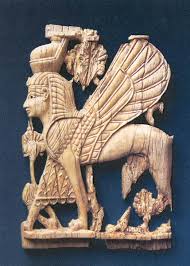
You were the anointed cherub who covers, The Cherub here is the next piece that typically trips people up. They see it and immediately their mind goes to the throne visions. The thing is Cherubs were not unique to Israel, they were throne guardians in the Ancient Near East, and the Phonecian kings often portrayed themselves as Cherubs.10 There is an example to the immediate left. They would set their thrones at the Temples and even priests had to gain their permission to ascend the ziggaraut.
And I placed you there. You were on the holy mountain of God; Commentators Jewish and not are conflicted on this bit. Either it could be talking about the famous mountain in the Kadisha valley that is represented on the modern Lebanese flag, and was both a high place for the Phonecians and where the cedars of the Jerusalem and Samaritan temples came from, or if it has to do with the idea of him making a name for himself by being the supplier of cedar for the Temple. I tend toward the former. You walked in the midst of the stones of fire. “You acquired for yourself a memorial with kings, who are like the ministering angels.” From the same aforementioned Jewish commentators.
So then how do we deal with the evolution of Satan from servant to cosmic force for evil? I see two possible roads. We can either accept the mystery and understand that the Scripture isn’t written to give us every answer, but what we need to know to live the life in Christ. If that doesn’t satisfy, then perhaps there is room to see these verses as types and shadows, while understanding that they are definitively talking about human kings. Personally I’m good with mystery. I think we get too easily off into error looking for answers Scripture doesn’t give.
- See Chapter 9 ↩︎
- See Also: Walton, John The Niv Application Commentary: Ezekiel Ez 28. Beale, Gregory A New Testament Biblical Theology and The Book of Revelation; Longman, Tremper III How to read Ezekiel Bauckham, Richard The Theology of the Book of Revelation; Block, Daniel I NICOT Ezekiel ↩︎
- https://www.wesleyhuff.com/can-i-trust-the-bible ↩︎
- Bava Batra 16a; Genesis Rabbah 56:4 ↩︎
- See Oswalt, John N. The Book of Isaiah NICOT; Goldingjay, John Isaiah Baker Commentary of the Old Testament; Seitz, Christopher r. Isaiah 1-39 Interpretation Commentary ↩︎
- Block, Daniel I The Book of Ezekiel NICOT; Duguid, Iain M, Ezekiel NIV Application Commentary Longman, Tremper III Ezekiel Story of God Commentary ↩︎
- Q4 and Q3 both have a large number of commentaries on Ezekiel, and while they see a prophetic doubling, meaning they see Ezekiel talking about the king of Tyre, they also have lots of guesses about future kings and tyrants that it is also talking about. However, they are always flesh and blood humans, typically different Roman Emperors. ↩︎
- 27:23, 31:8-9; 31:16; 31:18 ↩︎
- None of these make up their interpreations from whole cloth so to speak. If you read in the classic Jewish printing of the bible with commentary known as the Mikraot Gedolot, there are super commentaries Mizrachi and Siftei Hakhamim that list their sources in previous literature. ↩︎
- Block, Daniel I The Book of Ezekiel NICOT; Duguid, Iain M, Ezekiel NIV Application Commentary Longman, Tremper III Ezekiel Story of God Commentary; Smith, Mark S. The Origins of Biblical Monotheism; Keel, Othmar, Symbolism of the Biblical World ↩︎
 Musical Musings
Leave a comment