Might as well start at the beginning. See before ITunes came around and decided to call everything a song for simplicity and that entered into the vernacular, Song had a simple definintion: A musical composition performed by the human voice. You could have a song without instrumentation, but you couldn’t have one without words and voices.
That is a good start but let’s go even further back and build a Biblical Theology of song. In Hebrew the verb for Song is שיר Shir in Greek it is ᾄδω Ado. Don’t worry I’m not going to get into paragraph long explanation of what either of those words mean. Their meaning is simply, “Sing”. That’s it. Pro tip: words only form paragraphs after they are joined with other words into sentences, and those sentences are joined into Paragraphs. Anyone telling you a word means a paragraph long definition is probably not steering you straight.
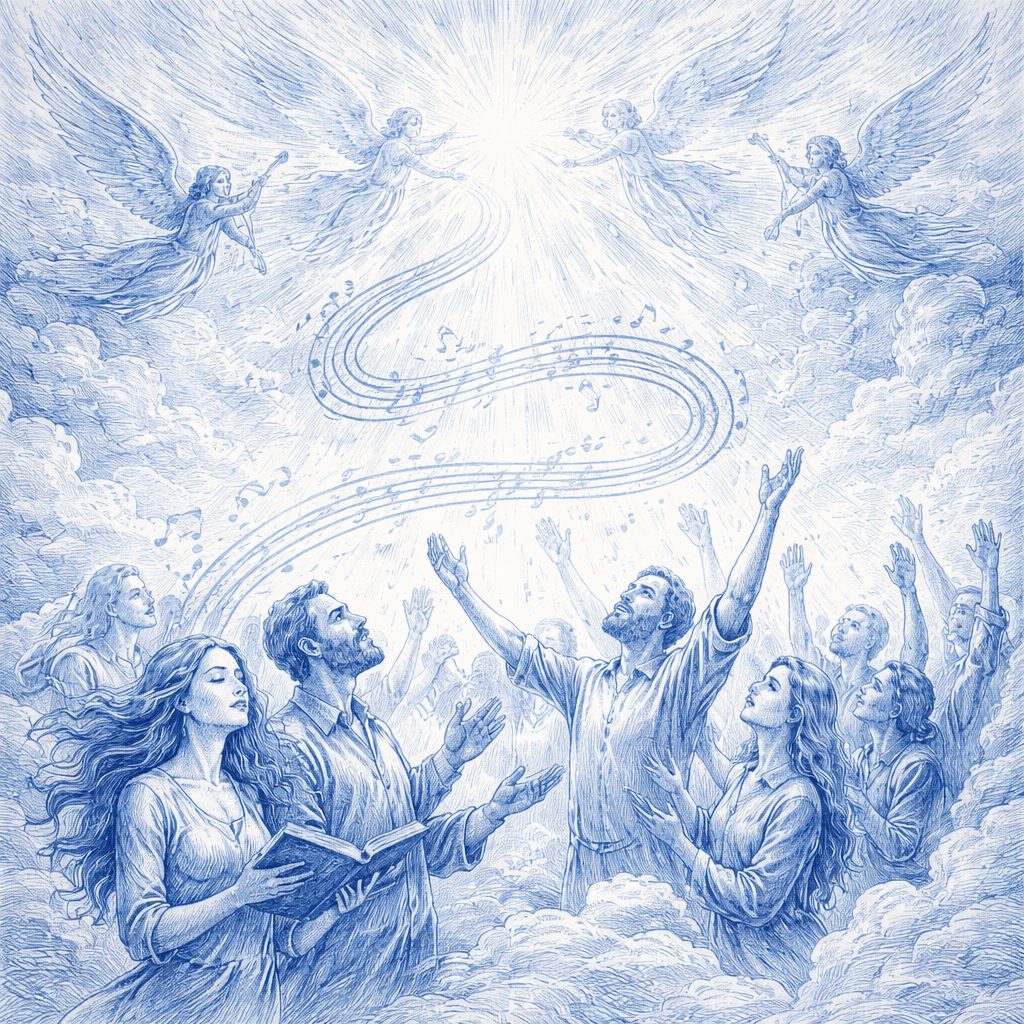
Great so now we have a word(or words as the case may be) now comes the Biblical theology part. This is where it gets profoundly interesting. Biblically the word is first used in Exodus 15 the Song of Moses as the Israelites come out of the sea. It is last used in Revelation 15 the Song of Moses and the Lamb where God’s people are finally redeemed. Between those two book ends, the this word is ONLY EVER used in reference to the redeemed people of God.
I know what you are thinking. Are you saying hark the herald angels didn’t sing? What about Job 38:7? What about the Pagans and prophets of Baal? So taking them in order I will assert once more that no where in Scripture are the verbs Shir orAdo applied to Angels. So personally I am agnostic on whether Angels sing. Job 38:7 בְּרָן־יַחַד כּוֹכְבֵי־בֹקֶר וַיָּרִיעוּ כָּל־בְּנֵי אֱלֹהִים which transliterated says, beran-yaḥad kokhvei-boqer vayariʿu kol-bene elohim. While it is often translated as something like When the morning stars sang together, and all the sons of God shouted for joy. The sang there is the Hebrew word רנן RaNaN which more means to ululate or melodically shout. This actually strengthens the case. It is quite probable as the majority of translators believe, that the authors intended for sing to be understood there, but sing is not a word that the Bible applies to anything or anyone outside of the redeemed people of God. Meaning Scripture from Genesis to Revelation is consistent in this point, even if the reality that it is trying to describe would be observably different.
So whether the Angels, the Great Cloud of Witnesses, or Pagan prophets of Baal, they always use an euphemism like “called” “shouted” or “said”. “Each of the four living creatures had six wings and was covered with eyes all around, even under its wings. Day and night they never stop saying… the twenty-four elders fall down before him who sits on the throne and worship him who lives for ever and ever. They lay their crowns before the throne and say:”(Rev 4:8-10)
Ramifications:
Since Scripture exclusively reserves the verbs שׁיר (shir) and ᾄδω (adō) for the covenant people of God, then singing simply cannot be understood merely as artistic expression. It becomes a covenantal act of participation. Something God’s people do because they belong to Him. Just as Israel’s identity was expressed through practices like prayer, sacrifice, and covenant remembrance, singing functions as an embodied declaration of belonging. When the people of God sing, they are not simply describing God’s works; they are participating in the relationship those works establish.
Revelation explicitly links prayer and song. In Revelation 5:8–9, the elders hold bowls filled with the prayers of the saints, and immediately afterward the heavenly assembly sings the new song. The structure suggests continuity rather than separation: the song becomes the articulated form of the saints’ prayer. In this sense singing functions as a liturgical extension of prayer. Another, more powerful, mode through which the covenant community addresses God. The voice of song is not separate from prayer but an intensified form of it, where proclamation, devotion, and theology converge. “He who sings prays twice”(arranged chronologically- Athanasius of Alexandria, Ephrem the Syrian, Basil the Great, John Chrysostom, Augustine of Hippo… Martin Luther). It is a sentiment that flowed from the earliest Church fathers into the Reformation.[We’ll deal with this more in a future post on the fight to keep prayer in the hands of the people].
Singing is the Response to Redemption. Across Scripture, songs consistently arise in response to acts of divine deliverance. Israel sings after crossing the Red Sea, Deborah sings after victory over Sisera, David sings after deliverance from his enemies, and the redeemed in Revelation sing because the Lamb has ransomed them by His blood. The pattern is striking: song follows, and is response to salvation. This suggests that singing is the covenant community’s ritual response to redemption, a way of publicly acknowledging and interpreting the saving acts of God.
Singing is a Marker of Covenant Identity. Because these verbs appear exclusively in connection with God’s people, singing functions as a marker of covenant identity. It distinguishes those who participate in God’s saving work from those who merely observe it. Angels proclaim God’s glory and cry out in praise, but the language of singing belongs particularly to the redeemed. Song therefore becomes one of the ways Scripture marks the boundary of the covenant community. The people who know God not only as Creator but as Redeemer.
Singing is Liturgical Rather Than Aesthetic. This pattern radically reframes the meaning of sacred music. In modern contexts singing is often evaluated aesthetically, by beauty, emotional power, or artistic skill. In Scripture, however, singing is primarily liturgical. It exists within the gathered worship of the people of God and serves the purpose of proclamation, remembrance, and communal prayer. The emphasis is not on musical excellence but on the act of the covenant community lifting its voice together in response to God’s saving work.
Singing as part of Humanity’s Priestly Role in Creation. Humanity is portrayed in Scripture as the priestly representative of creation, the creature uniquely capable of articulating praise to God. Creation declares God’s glory and the heavens proclaim His handiwork, but the redeemed community gives voice to that praise and petition through song. In this sense singing reflects humanity’s priestly vocation: the people of God become the articulating voice of creation, offering conscious and communal praise and petition before God.
The Meaning of the “New Song”. Within this framework, the biblical motif of the “new song” takes on deeper meaning. A new song is not merely a newly composed piece of music but the proper response to a new act of redemption. Whenever God performs a decisive saving work, whether in Israel’s history or in the final victory of the Lamb, the people of God respond with a new song. The “new song” therefore marks the unfolding story of salvation, culminating in Revelation where the redeemed sing the Song of Moses and the Lamb, uniting the first great act of deliverance with the final redemption of creation.
There is a lot more that needs to be said. We haven’t really touched on petition, lament, complaint, imprecation, all of which found their voice in the songs of Israel and the Church. We have only brushed up against some sacred cows, like “new songs from heaven” and “Satan as the first worship leader”. Those are all posts in and of themselves. However, we have uncovered the bedrock of Biblical Theology of Song upon which we can build a foundations and doctrines.

 Musical Musings
Leave a reply to Is Satan the Primordial Worship Leader? Debunking Myths Cancel reply